Channel Islands National Park News Release
Initial Assessment Indicates Potential for 80% Mortality Among Rare Torrey Pines Following Santa Rosa Island Fire
Restoration efforts are underway to assist long-term recovery of Torrey pine forest and preservation of island ecosystem
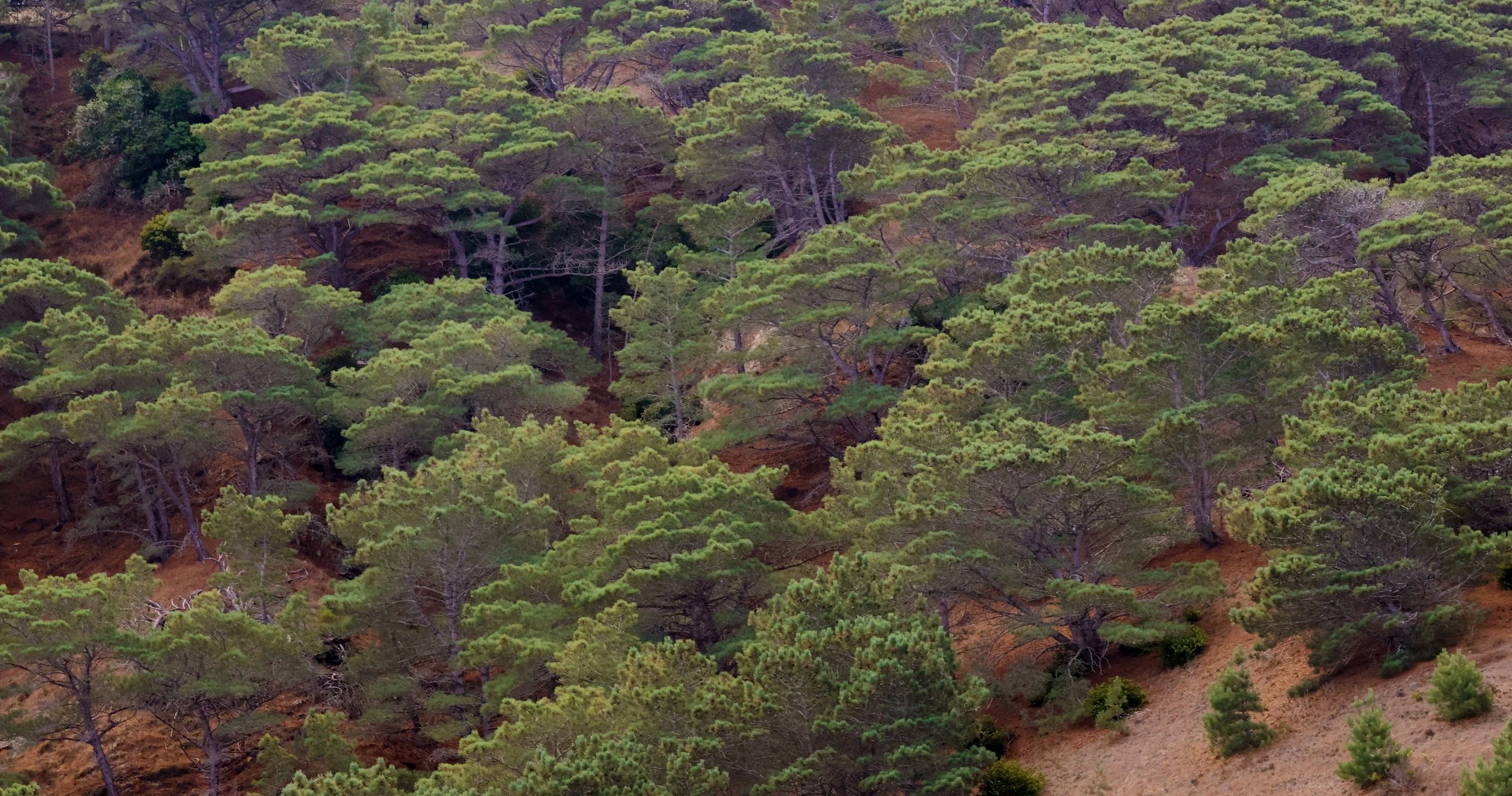
Torrey Pine in an Area with Low Burn Severity. Even Torrey pines that burned at low severity show signs of fire damage, including exposed shallow roots, scorching high into their crowns, and charred root collars.
A National Park Service biologist holds Torrey pine seeds collected on Santa Rosa Island for restoration following the Santa Rosa Island Fire. Photo credit: Department of Interior/A. Cholo
VENTURA, Calif. – Initial assessments indicate that 60% to 80% of Santa Rosa Island's iconic Torrey pines may perish as a result of the largest wildfire in Channel Islands National Park history.
In response, park officials have initiated urgent measures to stabilize this rare forest before the fall rainy season threatens its prospects for long-term recovery.
The Santa Rosa Island Fire burned 18,379 acres, almost two-fifths of the island, between May 15 and June 4, 2026. While many of the island's grasslands and shrubs are expected to recover naturally, the fire severely impacted the island's globally rare Torrey pine grove, one of only two naturally occurring Torrey pine populations in the world, and the only location for the island subspecies.
The most recent inventory, conducted in 2014, documented more than 24,000 Torrey pines of all ages on Santa Rosa Island, including approximately 3,000 mature, cone-producing trees.
Erosion-control crews are working to stabilize burned slopes while another team is already preparing for the forest's future.
Park staff and cooperators have collected more than 14,000 Torrey pine seeds released from cones after the fire. Viable seeds will be propagated in an island nursery and grown into seedlings that will eventually be planted in key locations within the burned grove. The remaining viable seeds will be broadcast and placed in a seed bank.
Under the park's Emergency Stabilization and Rehabilitation Plan, approximately 300 to 500 seedlings could be planted each year across a 15-acre restoration area.
National Park Service biologist David Mazurkiewicz, who is leading post-fire restoration efforts on Santa Rosa Island, examines a Torrey pinecone for viable seeds. Photo credit: Department of Interior/A. Cholo
Burned hillsides within the Torrey pine grove are highly vulnerable to erosion, and intense winter storms could wash away the fragile topsoil needed for future restoration.
"The potential loss of so many mature Torrey pines is heartbreaking," said Channel Islands National Park Superintendent Ethan McKinley. "But we must resolve ourselves to focus on what we can save, and the next few months are critical. The fire may be over, but we're now in a race against time. Protecting these slopes before winter storms arrive gives us the best opportunity to restore this extraordinary landscape for future generations."
Crews and volunteers are beginning emergency work to stabilize burned hillsides by installing wattles, long tubes made of natural fibers that slow rainwater and help keep soil from washing away. These treatments are designed to hold soil and seeds in place until native vegetation begins to recover naturally.
About 250 wattles (over 4,500 linear feet) have already been rolled.
While many mature trees cannot be saved, biologists say the soil beneath them can. If heavy winter rains wash away the remaining topsoil, it could significantly reduce the success of future reforestation efforts.
A recently completed Burned Area Emergency Response (BAER) assessment identified protecting the Torrey pine grove as one of the park's highest priorities before the onset of winter weather.
Based on those findings, the park's Emergency Stabilization and Rehabilitation Plan recommends cleaning culverts to protect the island's road system, reducing flood risks around Water Canyon Campground, stabilizing vulnerable archeological sites, repairing damaged trails, and monitoring and treating invasive plants that could spread following the fire.
Burned slope above Water Canyon Campground - Hillsides burned above tent sites at Water Canyon, which increases the risk of debris flow that could harm campers.
Volunteers working out of the plant nursery on Santa Rosa Island roll natural fiber wattles that will help slow rainwater and reduce erosion in the Torrey pine grove. Photo credit: Department of Interior/A. Cholo
The park is drawing on more than 15 years of restoration experience on Santa Rosa Island. National Park Service staff, the United States Geological Survey, California Institute of Environmental Studies, and other partners have developed techniques to restore the island's rare cloud forest, reversing decades of erosion and habitat loss. Many of the same restoration techniques, from erosion control to native plant propagation, will now be used to help recover the Torrey pine forest.
The National Park Service will work with numerous partners throughout the recovery, including the Santa Ynez Band of Chumash Indians, whose members have played an important role in the stewardship of Santa Rosa Island's native ecosystems and are expected to assist with future restoration efforts.
Visitors will begin seeing restoration work immediately, but full recovery of the Torrey pine forest will take generations.
For more information related to the Burned Area Emergency Response, visit the Santa Rosa Island Fire website.
Progression Map of the 2026 Santa Rosa Island Fire - The Santa Rosa Island Fire grew to 18,379 acres between discovery on May 15 and containment on May 21, 2026.
About the National Park Service. Established in 1916, the National Park Service preserves America's most treasured natural and cultural places for the enjoyment, education, and inspiration of current and future generations. Learn more at nps.gov.
Native Plants Through an Artist's Eyes:
A Story of Curiosity and Conservation
By Kristen M. Walker, MCDM BA
Kristen M. Walker scouting on Santa Cruz Island
I had visited the Channel Islands many times before, but this past January was the first time I’d seen the islands through an artist’s eyes.
I had just stepped away from my corporate communications job of ten years to spend more time with my family—and to take what felt, at the time, like an Indiana Jones and the Last Crusade-style leap of faith by starting my own fine art business. I wanted to paint the native and endemic plants of the Channel Islands to help my community connect with these remarkable places and feel inspired to protect them. So I was understandably excited to get started when my husband and I pitched our tent on Santa Cruz Island that cold, clear weekend in January.
Kristen M. Walker painting on Santa Cruz Island
We set aside the entire day Saturday for hiking, sketching, and taking photos. We left camp early and climbed toward Montañon Ridge, the highest point within the National Park on the eastern side of the island. The hike was steep, exposed, and relentless—a red dirt trail winding steadily uphill with no tree cover. At first, I was focused on my own discomfort, the effort of putting one foot in front of the other.
Then I noticed something. Or rather, I almost stepped on something.
A small, pale green plant growing out of the red rocks in the middle of the trail. As I continued to ascend, I found more of these endearing plants. Some were tiny and almost white. Others offered silvery green new leaves, emerald-colored old growth, and cheerful yellow flowers.
My informational guide identified them as Hazardia detonsa, or Island Bristleweed. I circled the name, marked the location on my map, and kept climbing.
When I reached the ridgeline, I was taken aback. There, alone on the edge of a rocky cliff, bathed in warm afternoon sunlight, was a remarkably stately hazardia. The clear blue sky and rolling hills of western Santa Cruz Island stretched out behind it. The plant seemed almost self-aware, as though it had quietly set its mind to stand tall despite the wind and the heat of the day doing their best to knock it down.
I spent a few minutes just observing. I took notes, snapped reference photos, and tucked the moment away in my memory.
A few weeks later, back home in my art studio, I pulled out those notes and reference photos and looked up Hazardia detonsa. From the moment I started reading, I knew I’d discovered the subject of one of my first Channel Island plant portraits.
Hazardia detonsa is rare perennial shrub that’s endemic to just three of the eight California Channel Islands. In the mid-1800s, commercial ranching dramatically transformed the landscape Santa Cruz Island and reduced the population of many endemic species, including the island hazardia. However, with more recent conservation efforts and the removal of feral sheep, the Hazardia detonsa is making an incredible comeback. The presence of unique species like this plant helps build the foundation of an entire fragile ecosystem, which supports countless other species including native pollinators like bees and butterflies.
I hope that my art encourages people to slow down, notice the remarkable plants that often go
unnoticed, and become curious about the stories they tell. The next time you’re on a trail, pause beside a native plant. Spend a minute really looking at it. Learn its name. You never know what it might teach you, or how it might inspire you to help protect the wild places it calls home.
Fraser Point with CIR this past spring
About the Artist
Kristen M. Walker is a Santa Barbara artist whose paintings celebrate the native and endemic plants of California's Channel Islands, inspiring curiosity, connection, and conservation. Her newest collection debuts this September at Gallery 113 in Santa Barbara. Fifteen percent of her original art and print sales are donated to Channel Islands Restoration.
Sources:
1. Riley, Jim. Plant Guide: Channel Islands and Natural History, Channel Islands, CA. BRIT Press, 2023
2. California Native Plant Society. Calscape: Hazardia detonsa (Northern Island Haplopappus). https://calscape.org/plant/1816/Hazardia-detonsa-(Northern-Island-Haplopappus)
Channel Islands Restoration Nears Completion of First Phase of Chumash Ethnobotanical Garden at the San Marcos Foothills Preserve
By John Ziegler, Channel Islands Restoration's Marketing Director
The entrance and new sign at the Chumash Ethnobotanical Garden at the San Marcos Foothills Preserve
Channel Islands Restoration (CIR), in close partnership with local Chumash community members, is nearing completion of the first phase of a new ethnobotanical garden at the San Marcos Foothills West Mesa. The garden is designed to celebrate the region's native plants while sharing the enduring cultural knowledge of the Chumash people, whose unceded ancestral lands include the San Marcos Foothills.
Ernestine Ygnacio-De Soto in 2008 at the National Museum of the American Indian, where she was consulting on their “Infinity of Nations” exhibit. She is holding a tomol effigy from Santa Barbara’s Burton Mound | Credit: John Johnson
The project was conceived by respected Chumash Elder Ernestine Ygnacio-De Soto and is dedicated in her memory. The garden honors her vision of creating a living space where visitors can learn about the ecological and cultural importance of California's native plants and the deep relationship the Chumash people have maintained with them for thousands of years.
Since launching the project, Channel Islands Restoration has worked closely with local Chumash representatives to establish a diverse collection of native plants, including California's state grass, purple needlegrass (Stipa pulchra). To date, 22 native plant species have been installed, with many more planned in the coming months and years. You can see all the plants here: https://cirweb.org/garden
Every species featured in the garden grows naturally within the San Marcos Foothills ecosystem and has been propagated at Channel Islands Restoration's and Santa Barbara Botanic Garden’s More Ranch Native Plant Nursery. The garden showcases plants traditionally used by the Chumash for food, medicine, fiber, tools, and other everyday purposes, providing visitors with a deeper understanding of the cultural and ecological significance of the landscape.
Ethnobotanical garden plants are propagated at Channel Islands Restoration's and Santa Barbara Botanic Garden’s More Ranch Native Plant Nursery
As part of the next phase of the project, interpretive signs will be installed throughout the garden. Each sign will display the plant's name in multiple languages and include QR codes linking visitors to online resources that describe how the plants have been—and continue to be—used by the Chumash community.
In conjunction with the garden installation, Channel Islands Restoration has also made improvements to the West Mesa trail system to enhance the visitor experience while helping protect the area's sensitive native habitats and wildlife.
CIR Volunteers installing native plants at the ethnobotanical garden at San Marcos Foothills Preserve
"The ethnobotanical garden represents an opportunity to connect people with the natural and cultural history of the San Marcos Foothills," said Channel Islands Restoration. "By combining native habitat restoration with cultural interpretation, we hope visitors leave with a greater appreciation for the plants, wildlife, and Indigenous stewardship that have shaped this landscape for generations."
The ethnobotanical garden serves as both an educational resource and a place of reflection, inviting visitors to recognize and honor the Chumash people and their ancestors while exploring the native plants that continue to thrive in this remarkable landscape.
It is named, ʼal-tipašumawiš, meaning “one at peace” which is pronounced as follows:
all-ti-paw-shoo-MAW-weesh
'all' rhymes with 'call' 'ti' are the first two letters in the word 'tick' or 'tickle'
'paw' rhymes with 'saw'
'shoo' rhymes with 'blue'
'MAW' rhymes with 'saw'.
It's in capital letters because this syllable takes the stress.
'weesh' rhymes with 'leash'
Autumn Equinox Tour 2026
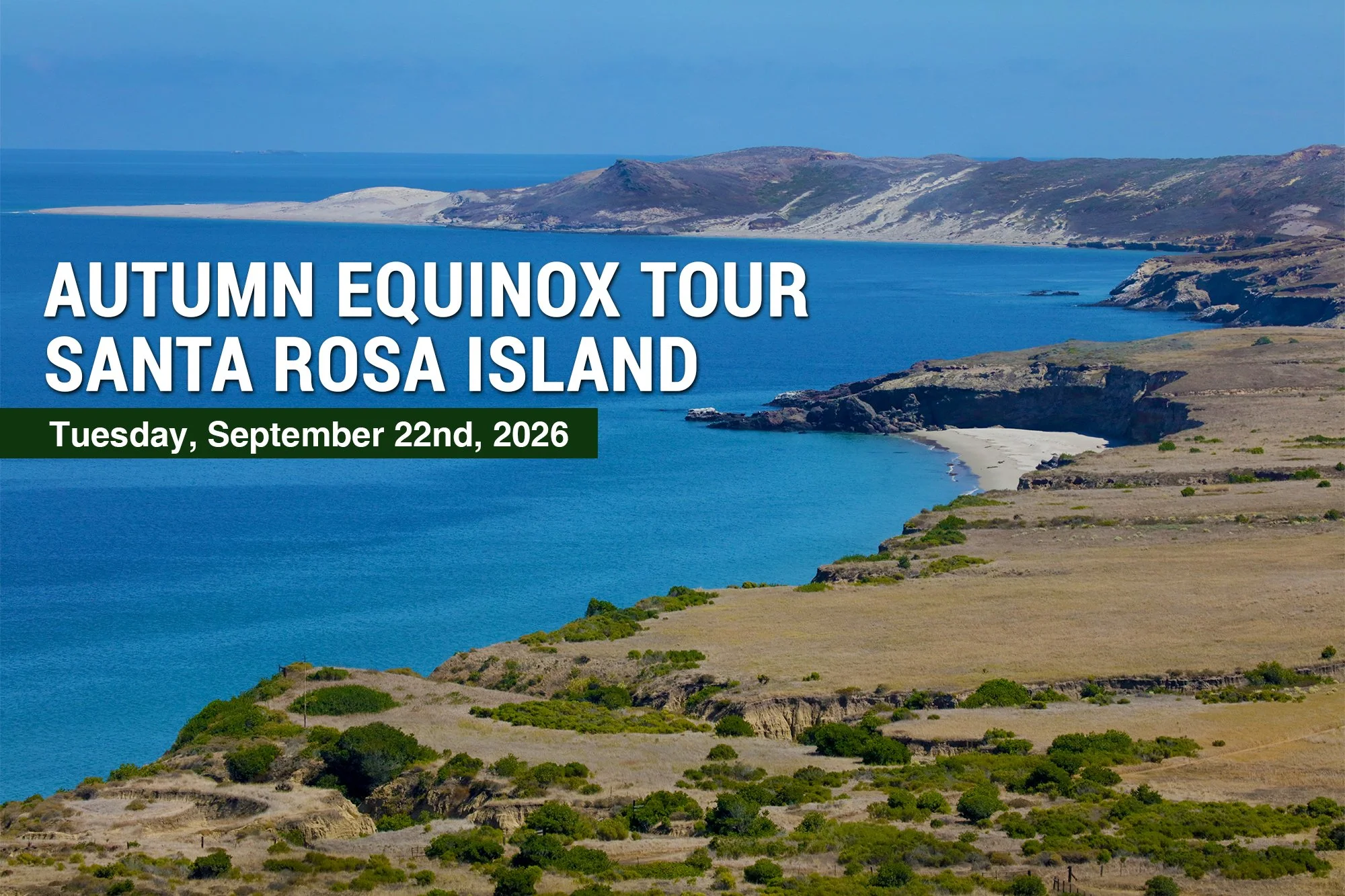
Experience Santa Rosa Island during our AUTUMN EQUINOX CRUISE!
Tuesday, September 22nd, 2026
A Fundraiser for the East Santa Cruz Island Restoration Project
Channel Islands Restoration is excited to bring you a trip to the beautiful and remote Santa Rosa Island, where you will enjoy spectacular views, great company, and ample time to enjoy island life among friends. Learn about the island's history, geology, and ecology among peers and like-minded environmental enthusiasts! Join us in exploring sandy white beaches, hiking the breathtaking Cherry Canyon, and much more! We’re looking forward to the island adventure!
The island cruise is available to everyone. You don’t have to be a CIR member to join us.
A 25% discount is available to Island Fox Members, and a 15% discount is available to Island Ironwood Members.
Please contact John Ziegler at john@cirweb.org or 805.448.1501 for questions and information regarding this event.